
Management11 min read
Complete guide to understanding project risk management!
Understand what project risk management is, what are its practices and tools. Check it out!

Every project has a large number of risks that can affect it or even make it unfeasible. For example, accidents at work, technological breakdowns, natural disasters, and interpersonal conflicts. How, then, to promote risk management in projects?
It is not a trivial task, it requires a lot of time and energy from the manager and his team. It is necessary to assess the main sources of risk, in addition to creating prevention and containment plans. It is still necessary to learn from the failures, drawing lessons so that the same mistake does not occur in the future.
In the following topics, we explain the matter carefully. You will understand what project risk management is, what are its practices and tools. Have a good read!
What is the concept of project risk management?
To understand what project risk management is, let’s understand its words separately — management, risk, and project. Only then, condense them into a single concept.
First, we have management. It refers to the stages of planning, executing, and controlling certain resources, in order to achieve efficiency and effectiveness. Then there is a risk. It concerns everything that could cause harm to the company or its interested parties.
Finally, there is the project. It consists of an effort, previously planned, to create a good, service, or process. It should be noted that every project is temporary, that is, it has a beginning, middle and end, which vary according to its scope and available resources.
Therefore, we can say that project risk management refers to the stages of planning, executing, and controlling certain resources to identify and mitigate risks, especially the most serious and probable, in order to ensure that the project, from start to finish, is fluent and meets the previously defined parameters.
The better risk management, the better the results of the company and the team itself. On the other hand, if the matter is despised, everyone could be harmed.
- Discover 6 retail marketing indicators!
- Marketing team management: how to do it strategically and productively?
- Agile management: understand what it is, what is its importance and how to do it
What is the importance of risk management in projects?
Proper risk management is really important. When the manager and his team work to anticipate problems, optimize the company’s strengths and avoid certain market threats, the project can run more smoothly and successfully.
Imagine the following: a manager chooses to develop a new product, which is expensive. However, it fails to evaluate certain variables, such as the “cash” available. Some time later, she realizes that she has no more financial resources and she needs to abort the project.
At first, it seems that the manager and company lost money. It’s true, but not only that. They also wasted time and energy. They still faced an opportunity cost, as they could have used those resources on a better project.
Below, we list some of the benefits that make risk management crucial:
- allows the anticipation of problems;
- ensures that the team eliminates its weaknesses and develops its strengths;
- supports optimal strategic planning;
- reduces the number of accidents, as well as interpersonal conflicts;
- subsidizes faster and more accurate management decisions;
- increases the earning potential with the project.
All of these benefits can be summarized as follows: competitiveness. Good risk management ensures that the project is competitive and promotes better results for the company. The opposite is true, making it dangerous to underestimate risks.
What are the stages of risk management in projects?
Risk management can be seen as a set of steps, a kind of step by step. It all starts with the diagnosis of potential risks, which can then be classified according to impact and probability. See more, below.
1. Make the diagnosis of the main risks
The first step is to have an overview of the risks surrounding your project. They can vary quite a bit. If you’re building a house, you don’t expect to face the same risks as someone who’s modeling software. So, remember: each case is a case.
At first, this diagnosis depends on looking at the threats that are outside the company, then at the weaknesses that are part of the enterprise. In this way, the manager can develop a holistic view and identify a greater number of risks.
In that case, remember the old jargon: many heads think better than one. Then, take the opportunity to involve the work team that will be part of the project. Start a brainstorming-type meeting, which stimulates the creativity of talents in diagnosing risks.
- What are the main benefits of the marketing management system?
- Do you know how to increase creativity? Today we will teach you how!
- Marketing team management: how to do it strategically and productively?
2. Analyze and classify the main risks
Once you have surveyed the main risks that may affect your project, it’s time to analyze and classify them. This will ensure that you and your team have more control.
In this case, it is interesting to create a risk matrix. This matrix classifies each risk according to two factors: impact and probability of occurrence, with scores of 1 to 5 points. So, the higher the final score, the greater the risk and the better your plan should be.
An accident at work, for example, has a high impact (4 points) and a reasonable probability of occurrence (score 3). Therefore, it is something that must certainly be studied.
3. Anticipate the risks with the highest impact and probability
A third step is anticipation. If you understand the risks, their impact, and likelihood of occurrence, it’s time to take a step forward. This depends on a more holistic view, considering what must be done, how, when, and by whom.
In this case, it is worth relying on the 5W2H tool. This tool is actually an acronym for 7 questions with an English origin. Check it out:
- what: what should be done?
- why: why should it be done?
- who: who should do this?
- where: where will it be done?
- when: when?
- how: how will this be done?
- how much: how much will it cost?
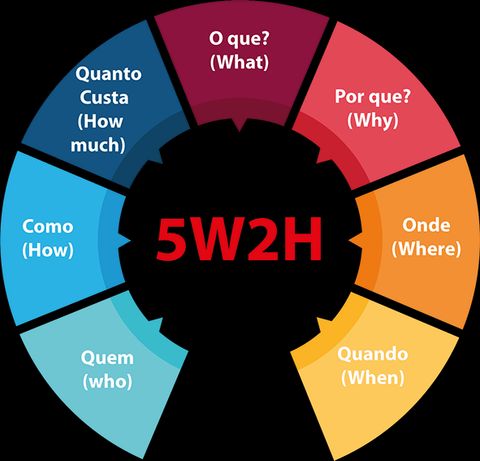
Imagine that the risk is an accident at work. To get ahead of time, use the 5W2H tool and answer each question carefully. Whenever possible, involve an expert to help with the answers, as this way you will have more complete and accurate answers.
Monitor established risks
The last step concerns monitoring. If you know what the risks are and how you can anticipate them, it’s time to consider how to monitor their likelihood of occurrence. In this case, the most important thing is to have a good set of performance indicators.
The indicators vary depending on your project. In that case, if the project is in the marketing area, marketing indicators will be needed. Check out some examples:
- level of staff satisfaction;
- number of errors, failures, and interpersonal conflicts;
- customer churn rate;
- performance of products in the market;
- micro and macroeconomic indicators;
- market share level.
By monitoring good indicators, your project can adopt an optimal business intelligence practice. This means that the data will be used for the benefit of the project, anticipating possible threats and identifying opportunities to obtain more benefits.
What are the tools for project management?
In the previous topic, we highlighted two tools that can help with project management - Risk Matrix and 5W2H. However, there are several others. They offer a more holistic view to the manager and work team, and they also allow for a precise answer. Check it out!
1. SWOT Matrix
The SWOT matrix is a great tool. It is used in strategic planning to diagnose the internal and external environment, cataloguing opportunities, threats, strengths, and weaknesses that exist. Thus, it allows the manager to have a systemic view.
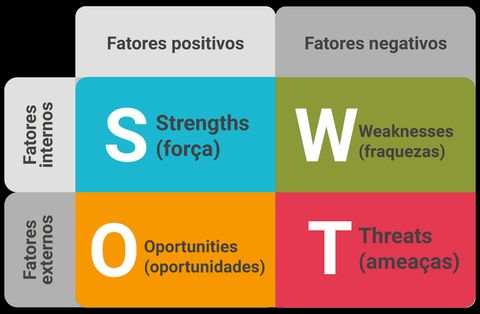
In the case of risk management, it is interesting to use this tool even in the first stage (diagnosis). It will allow the manager to know exactly what to avoid when touching the project, as well as what can be used to obtain additional benefits.
Its use is fairly simple. Start by monitoring the indoor environment. Classify resources that are under your control as strengths or weaknesses. Then look at the external environment, defining your variables as opportunities or threats.
2. Ishikawa diagram
In the second stage, which seeks to analyze and classify risks, in addition to the Risk Matrix, it is interesting to have the Ishikawa Diagram. This tool is very popular in total quality management (TQM) programs.
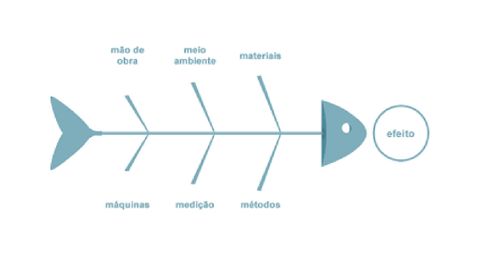
Its use is simple: you will select an effect that you want to study. In that case, a risk. Imagine that it is the risk of an accident at work, mentioned before. Next, it will analyze the potential causes of this risk. The diagram is based on 6 causes, called 6Ms:
- machine: causes resulting from software or hardware;
- labor: problem related to the lack of training or courage of the team;
- material: in this case, the cause is the use of inappropriate inputs;
- environment: refers to the workplace, if appropriate;
- measure: refers to the metrics and indicators used in the project;
- method: refers to the work process, which can also generate risks.
Therefore, you will look at those 6Ms and assess which ones may be generating the risk you are studying. Next, you will delve into some of these Ms, evaluating them more deeply until you find the so-called “root cause” of the problem.
Failure Mode and Effect Analysis
The Failure Mode and Effect Analysis (FMEA) method, which stands for analysis of failure modes and effects, is another important tool. It allows the identification of certain risks to the project, as well as the definition of their probable causes and means of detection.
To use FMEA to your advantage, it’s important to:
- define what will be analyzed (good, service or process);
- define the failure mode (that is, the risk affecting operation);
- identify the effects of this failure;
- identify the causes of this failure (in this case, combine with the Ishikawa Diagram);
- define how this cause will be detected;
- Establish a deadline and be responsible for preventive action.
Imagine, for example, that you will analyze the digital transformation process of your marketing sector. Note, then, that a risk is a technological crash. The effects are various, such as the shutdown of systems. The cause is the lack of system updates.
By putting all of this on paper, you will have a detailed matrix with risks, effects and causes, which can support detailed action throughout your project.
Project Management Body of Knowledge
Finally, remember to count on the PMBOK (Project Management Body of Knowledge). In short, it consists of a kind of encyclopedia created to indicate best practices during project management, instructing the manager on what to do and what not to do.
The PMBOK was created by the Project Management Institute, an international non-profit organization that regulates, trains, and develops best practices for project management. This way, you can adopt best practices and reduce the number of risks.
6. What is the importance of continuous risk management?
As you can see, risk management is essential, but it depends on good practices and functional tools. A frequently asked question is the following: for how long to invest in this management? The ideal is until the project is completed, on an ongoing basis.
In this case, a good tool is the PDCA. It consists of the improvement cycle that begins with the planning (Plan) of what must be done and gives rise to the execution (Do) of the plan, which is then checked (Check) to identify flaws and promote corrective actions (Act).
This provides a number of additional benefits to the project, here are some of the main ones:
- progressively reduces the number of errors;
- ensures that past problems do not reoccur;
- saves the company’s financial resources;
- creates a culture of total quality over the course of the project;
- communicates to talents that quality is essential.
When ongoing risk management is set aside, the entire company can suffer. Failure costs are higher. There are also additional risks to the lives of professionals. These issues can affect the company’s survival.
7. Key mistakes to avoid in risk management?
Some errors can affect project risk management, here are the main ones:
- do not combine management with additional techniques, such as agile management;
- deal with the issue individually, while the team wants to be involved;
- stop paying attention to digital practices, such as the management of publications;
- believe that intuition is sufficient, while real metrics are needed;
- stop having a good platform for managing resources.
Look, now you’re on top of the topic. Remember that project risk management refers to the stages of planning, executing, and controlling certain resources to identify and mitigate risks, especially the most serious and probable. Therefore, in addition to having good practices, it is necessary to adopt good tools and avoid errors that are frequent.
You liked our article, correct? Take the opportunity to subscribe to our newsletter and receive our news directly in your e-mail. Let’s go!